
What makes a hero? Spotlight post with Author Ellen Jacobson and Guys with Ties
To inspire hope and courage, I dedicate Monday posts through the months of March and April to authors and professionals on the subject of heroes, historically defined, and also the transformation in today’s society. I like to think of this term as the Everyday Hero. Here today, I have fellow author, Ellen Jacobson, answering three questions on the hero topic. I’ll also end this post with my Everyday Hero of the week, Assistant Principal N, Founder of Guys with Ties, a club focused on developing strong character and respectful manners to set students up for future career success.
***
About Her Story “The Silvering”
Could the gift of silvering become a prison for those who possessed it?
Caestu, an ordinary fisherman, disobeyed the principles which guide his people’s way of life. Fortunately, the mark of disobedience is hidden beneath his glove. Unfortunately, others know what he has done. Now he must decide whether to stay with his people or leave to search out others like him.
Spotlight on Author Ellen Jacobson
What is your definition of hero (historically or in today’s world), how does your hero fit the definition and then finally, why did he or she fall?
My first reaction to defining a hero is to characterize him/her as someone who fearlessly combats evil through extraordinary feats, superhuman powers or the like. But on reflection, I’m not sure if that’s really what a hero is.
When I think about all of the silent and unsung heroes who make a real difference in our world, what comes to mind are the small things that they do which would never make newspaper headlines, but do make life better for their friends, family and community. Or those people who change things in society, not through superhuman powers, but through persistent action which challenges the status quo.
Maybe a hero is someone who thinks of others first and seeks to improve their lives.
I think my hero, Caestu, is on a journey to be someone who puts others first, rather than selfishly bury his head in the sand and ignore what’s going on around him.
I don’t think of Caestu as someone who has fallen, although that might be an interesting theme to explore if I expand my short story, The Silvering, into a novella or novel one day.
About Author Ellen Jacobson
 Ellen Jacobson writes mystery and sci-fi/fantasy stories. She is currently working on the first in a cozy mystery series about a reluctant sailor turned amateur sleuth, as well as tales set on imaginary worlds. She lives on a sailboat with her husband, exploring the world from the water. When she isn’t working on boat projects or seeking out deserted islands, she blogs about their adventures.
Everyday Hero Assistant Elementary Principal N, Founder of the Club Guys with Ties
Guys with Ties is an elementary school club for boys in all grades from Kindergarten through fifth where they dress up once a week and model good manners and respect. Initiated by Assistant Principal N this past fall, the purpose is to improve the culture of caring and respect, and through positive peer pressure, create a widespread change in helping those around us. What began as a casual compliment to students who chose to dress up and have selfies taken with the principal, has now expanded to school clean up, classroom aid in conduct and modeling manners and chivalry. The hope is to show students how to apply manners and positive character traits to set them up to succeed in future careers and relationships.
 [Erika] Tell me about the purpose:
[Principal N] In some schools you work, you see a mix of socioeconomic situations. Some students don’t have male role models or any positive figures in their lives. I want to be a positive role model for my students and show them how to use good manners and be respectful, and also identify good character traits to help them succeed in their lives down the road. Businesses have come forward and donated bow ties for the school. We even have kindergarteners who stop into the office and take one to wear in class.
[Erika] Where did your inspiration come from to start this group?
[Principal N] My first year at this current elementary school, I noticed a group of boys who would randomly wear ties. They never wore them all on the same day. The principal and I would compliment them. Then later at the end of the school year we always hosted a holiday feast. We encouraged the entire school to dress up. We took pictures and the idea expanded from there. At every opportunity in school when the principal and I saw kids wearing ties, we’d take selfies with them so their buddies would see the pictures and want to do the same. We brainstormed how to reach all grades and find a time in the morning to have meetings. The group is still in the infant stages. Next fall my hope is to focus on community involvement on a greater scale. I also hope to determine a theme for each of the meetings, whether or not it’s a weekly or monthly theme has yet to be decided.
[Erika] What role will the community play?
[Principal N] I would like to have several speakers come meet with the boys. They could talk about their life instances and backgrounds and share how they might not have come from the best household or situation, but transformed their lives and worked hard to succeed. I want the community to inspire kids to succeed and share their successes. If a kid knows someone has struggled to make it, they might relate. I want the kids to also get involved with volunteer work, to help churches reach out and help with families and gather resources for victims who lost their homes in events like the recent tornado that came through and destroyed so many homes.
[Erika] How is the group helping kids and what’s the impact on school culture?
[Principal N] The focus is a behavior shift. We’re trying to create positive behaviors in the classroom. We strive to have kids recognize acceptable and nonacceptable behaviors. Students involved with the group look back and realize a choice might not have been the gentleman thing to do. We look out for opportunities to help: to pick up trash and litter, to help out in the office with shredding paper, and to also assist custodians with brooms, dust pans and trash.
[Erika] What happens in weekly meetings? Do any of the kids wear ties at home?
[Principal N] I try to meet with a group of students in each grade once a week. Monday, the 3rd graders. Tuesday, the 4th graders … Friday is a combination of Kindergarten and First graders. A total of 80 kids participate and sometimes the struggle is getting them all together to talk about a lesson. We talk about filling buckets. We implement something called “Atta Boy” compliments. It’s a reciprocal tally of giving compliments to others and also noting when we receive them. We keep track. The goal is to get students to recognize the good things that go on and to also understand how it feels to give and get compliments.
[Erika] Have they taken the idea and applied it to life like Scouts, Clubs or Sports?
[Principal N] I have received lots of parent feedback in how their kids need to get a shirt or a tie. They remark on changing behaviors in the home. Teachers comment on behavior changes in the classroom. I have a notepad with our logo on it. Teachers have them in their classrooms and write down when they see someone doing a gentlemen act. I get a copy and send it home with the student. We also recognize them in the lunchroom and hang up the note so their peers see it.
[Erika] What’s your biggest moment of making a difference?
[Principal N] I love when I watch a student do something unprovoked. A good character trait like opening a door for someone else or seeing trash somewhere and picking it up and throwing it away. I love it when the students come up with ideas for how to help the school on their own.
[Erika] Where are you now in comparison to where you began?
[Principal N] We’re still beginning. The routine to dress-up isn’t easy. We’re still learning what how to recognize opportunities to do something positive. I have a wonderful group of 4th graders this year. I stress to them about their leadership and set expectations high for them. I put a lot on their shoulders to help with the club. 1. They can handle it. 2 They set the foundation for the group next year. 3. They already come back with ideas to improve the school in positive ways.
One student came up and said, “I’d like to start tutoring.” So now I’m reaching out to our teachers and letting them know about the group and what we can do. Recently a librarian had a 2nd grader struggling to get ready and pack up for class. She asked our group if we could help and the guys enjoyed it. So they can be the leaders for next year.
[Erika] What are the plans for girls to get involved?
[Principal N] The hope is to get the girls club off the ground next fall. A group of fourth-grade girls came up to me and said they wanted to be involved. They had a name, Girl with Pearls. Right now, our principal who is a female would serve as their leader. She is more of an expert than I am on the subject. So far they are working to gather plastic beads and pearls for all the participants.
[Erika] Anything else you want the public to know?
[Principal N] I love what I do. I get a 100 hugs and high-fives a day from kindergarten to fifth graders.
Motto: “If you look good you feel good, if you feel good you do good.”
Thank you so much Ellen, for your thoughtful reflection today. I can’t wait to read your story! And thank you Assistant Principal N, for doing what you doing and being a great role model for so many young minds and hearts.

What Makes a Hero? Mini Interviews with Author Tyrean Martinson and Restore the Light Director Dana
To inspire hope and courage, I dedicate Monday posts through the months of March and April to authors and professionals on the subject of heroes, historically defined, and also the transformation in today’s society. I like to think of this term as the Everyday Hero. Here today, I have fellow author, Tyrean Martinson, answering three questions on the hero topic. I’ll also end this post with my Everyday Hero of the week, Dana, Executive Director of Restore the Light, a Nonprofit Human Trafficking Awareness Organization.
***
Tyrean’s Story, “Of Words and Swords”
In a time of dragons and dragon-slayers, Maud has lost his taste for battle. He wants only to put his swords to rest and follow his life-long dream to become a bard.
Mini Interview with Tyrean Martinson
[Erika] What is your definition of ‘hero’ (historically or in today’s world)?
[Tyrean] I think a hero endures hardship and risks his/her life (physical, social, or career) to save or help others or to save the world/community. I think this is true in historical and modern contexts.
Harriet Tubman is an example from American history. An American slave who escaped slavery, she returned to the South to help many slaves escape. She dedicated her life to helping others.
In modern times, we have heroes like Reverend Marin Luther King, Jr. and Mother Teresa, along with all the first responders on 9/11 and many others who give their lives and their time to others.
“When I was a boy and I would see scary things in the news, my mother would say to me, “Look for the helpers. You will always find people who are helping.” – Mr. Rogers
[Erika] How does your hero fit the definition and then finally, why did he or she fall?
[Tyrean] Maud gave up his dream of becoming a bard to become a dragon-slayer. After risking his life many times to save his kingdom from dragons, he’s given a large reward which enables him to pursue his old dream. He thinks that dragons will leave his kingdom alone – after all, he has killed dozens already and no one has seen one in a few years.
Maud falls because he’s tired of killing dragons and he is a bit selfish.
(I know that the current trend for dragons is that they are intelligent, talkative, and noble. Maud has never met a dragon like that.)
About Tyrean Martinson

Daydreamer, writer, teacher, believer – Tyrean Martinson lives near the Puget Sound with her husband and daughters. With her B.A. in Ed. and English, she teaches writing classes to home-school teens and she writes speculative, contemporary, poetry, experimental hint fiction, and writing books.
***
My Everyday Hero This Week: Dana, Executive Director of Restore the Light, a Nonprofit Human Trafficking Awareness Organization
According the U.S. Department of Homeland Security, Human trafficking is defined as:
“Modern-day slavery and involves the use of force, fraud, or coercion to obtain some type of labor or commercial sex act. Every year, millions of men, women, and children are trafficked in countries around the world, including the United States … Human trafficking is a hidden crime as victims rarely come forward to seek help because of language barriers, fear of the traffickers, and/or fear of law enforcement.”
Fact: 100,000 kids are sold into sex trafficking every year.
Fact: Currently 1.5 million victims in the U.S.
Fact: Human trafficking is a 32 billion dollar industry, and it’s growing in all 50 states.
Fact: According to Polaris Human Trafficking statics, states in the U.S. closest to water access, major highways and international airports, are number one trafficked locations.
Executive Director Dana, with the Nonprofit Organization, Restore the Light, had her eyes opened wide while sitting in church. Starting the organization from the ground up, Restore the Light aims to educate and be a proactive force for victims of human trafficking. Dana is not just an executive director and founder of this organization, but an assistant principal, a mother, and a wife, an active religious leader and above all things, a believer in standing up for what’s right when the world feels incredibly wrong. Dana is an everyday hero for her heart and her strength. She’s not afraid to say what many people think and are afraid to voice. Dana is a voice. Dana is a lighthouse in the dark.
[Erika] Tell me about the mission of Restore the Light.
[Dana] We aim to educate people about domestic human trafficking, sex trafficking and to increase awareness and allow for intervention of future victims of all ages and all backgrounds. Did you know the average age of entry is 11?
[Erika] No. I had no idea. I can’t even fathom that.
[Erika] Where did your inspiration come from to start this group?
[Dana] Honestly by nature, I have been a protector for the vulnerable. One day, sitting in church, I heard someone talking about people being trafficked from a truck stop 10 minutes from my location. I thought I work with young people. How did I not know that? How can I protect my students, if I don’t know these things? And then I wondered, who else doesn’t know this information? It started as a protection for my students, and now I push to spread the focus to all kids of that age.
[Erika] Where are you now in comparison to where you began?
[Dana] The organization began by word of mouth just talking to people about the definition of human trafficking. Now we have social media, a website and we go to organizations and colleges all over the state. We partner with local police departments to be a lead program. We educate in counselor development programs, coordinate and host defense classes. This year we plan to host a 5k and will continue to reach out to more universities and organizations.
[Erika] How many people do you touch?
[Dana] We touch nearly 250 in most conferences we present at. Recently we were asked to speak at a local chamber ground of 12 individuals. We mostly do presentations and self-defense classes to provide resources. We are about education, prevention, and intervention. The facts state, only 1 – 2 % who traffic actually get rescued. The best way to impact the community is to prevent it from ever happening. Human trafficking is the second fastest growing criminal industry in the United States behind drugs.
[Erika] What’s your biggest moment of making a difference?
[Dana] Honestly, a child came to me and said, “Hey, I heard you know a lot about trafficking, and I am worried about my friend being groomed for sextortion.” She’d believed it was a friend of a friend, but the friend had actually never met that person. So none of the connections were legit. I am glad I talk about human trafficking, so kids know the details. My big push is to teach people how it happens here in Kansas City. It happens world-wide every 30 seconds.
[Erika] Do you have an everyday hero?
[Dana] My mom. She had me as a teen and was basically homeless once she got pregnant with me. We moved a lot. I had 12 homes before I was 10. Still, my mom went to college and worked to get her degree, but she made sure I was taken care of. Now she has her doctorate, teaching in an OT program. She overcame all her struggles and because of her struggle, making excuses has never been an option for me.
[Erika] What struggles does the organization face?
[Dana] Honestly, time. People don’t like to talk about what’s uncomfortable. To hear our message, they have to be okay getting out of their comfort zone and to take off the rose colored glasses to see the ugly. It’s always ugly with kids. The big thing is, you can’t fight what you don’t know exists.
[Erika] What resources can we share with the public? Is there a safe place?
[Dana] To intervene, call law enforcement immediately. Here in KC, we have Veronica’s Voice, Restoration House, and Exodus cry. They work on the restoration side of human trafficking.
Want to know more about Restore the Light?
*RESTORE THE LIGHT IS NOT AN EMERGENCY RESOURCE*
If you are in IMMEDIATE need of assistance or in danger call 911.
If you or someone you know is a victim of human trafficking, contact the National Human Trafficking Resource Center.
United States: 1 (888) 373-7888
SMS: 233733 (Text “HELP” or “INFO”)
Hours: 24 hours, 7 days a week
Languages: English, Spanish
Website: www.traffickingresourcecenter.org
Instagram: restorethelight | Facebook | Leadership@restorethelight.org
***
Thank you, Tyrean Martinson for being here with me today. I can’t wait to read your story. And Dana, you inspire me to be a better and bigger person.
What Makes a Hero: Mini Interview with Author Jen Chandler, and A Local Firefighter
To inspire hope and courage, I dedicate Monday posts through the months of March and April to authors and professionals on the subject of heroes, historically defined, and also the transformation in today’s society. I like to think of this term as the Everyday Hero. Here today, I have fellow author, Jen Chandler, answering three questions on the hero topic. I’ll also end this post with my Everyday Hero of the week.
***
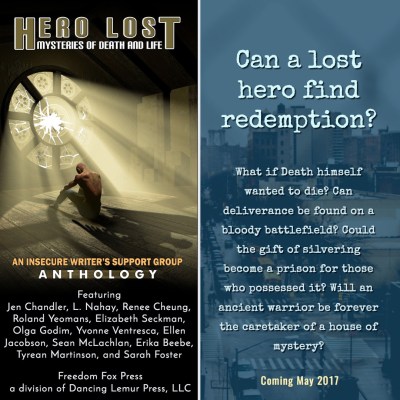
The Feature Story, “The Mysteries of Death and Life”
Can Death die? Is Death capable of love? A young, homeless woman named Leah meets the Angel of Death in an abandoned church and discovers that he longs for a release from his eternal work. If Leah can’t uncover the reason for his despair, the souls of the dying could be doomed to wander forever.
Mini Interview with Jen Chandler
[Erika] What is your definition of ‘hero’ (historically or in today’s world)?
[Jen] A hero, traditionally speaking, is anyone who finds him/herself addressing a threatening situation either for another person or for society in general and (usually) comes out on top. There are various types of heroes. The one we’re most inundated with at the moment is the Super Hero. A Super Hero is, of course, someone who has superhuman powers in some capacity and uses them the help mankind. I like to think of this as a hero who has heroism imposed upon them because their abilities far out weight those of the average human being. My personal favorite is the Reluctant Hero, or an average person who is willing to do what no one else is, whether by choice or by proxy.
[Erika] How does your hero fit the definition?
[Jen] My story is a little complex in that there are TWO heroes (dun, dun, DUN!). Both of these heroes are Reluctant Heroes even though one of them isn’t human and definitely has superhuman powers.
[Erika] Why did he or she fall?
[Jen] Gaston, my supernatural hero, fell because of his own fault. He becomes burdened by his job or his ‘heroism’ if you will. Leah’s heroism – she’s my human heroine – is much more subtle and understated. Her original fall from grace was caused by her parents’ poor decisions.
About Jen Chandler

Born and raised in the deep, dirty South, Jen Chandler cut her story-telling teeth in the old folktales of Appalachia. She grew up chasing ghosts and gods, devouring the myths and legends of Egypt, Greece, Ireland and the British Isles. Now happily ensconced beneath the moss laden oaks of Savannah, GA, Jen delights in rummaging into the dark corners of stories, re-imaging mythology and collecting ghosts, goblins, and other strange things that tap at the back door of her imagination. When not writing, Jen can be found drinking copious amounts of tea, designing and stitching fabric patterns, studying folk herbalism, and re-reading old copies of British Country Living with frightening regularity. She may or may not be addicted to gummy candy.
You can find her via her Blog
***
My Everyday Hero This Week: Firefighter/EMT
 The shift of a firefighter begins at 8:00 a.m. and completes nearly 24 hours later at 7:30 a.m. Staff prepares and test the equipment. They log every piece into a computer and mark it off as checked. During the week shifts, training classes keep the morning busy. Anything from new medical techniques, to hands-on fire ground related policies. After training comes lunch, testing the fire hoses and inspecting buildings. Calls come in and out and hopefully, the current staff gets to sleep, but not always. Everyone is roused at 7:15 a.m. the following morning, and the clean up begins to prepare for the next crew. Fresh crew members filter in and the last crew clocks out for the day. Today, I have with me Firefighter A, describing his day, his favorite and scariest moments on the job, as well as some particularly interesting historical facts. I have to say, this is by far, is the most difficult profession I’ve talked to yet. Firefighters deserve the utmost respect, and definitely more compensation than they get.
Disclaimer: Names and certain details have been changed to protect events and individuals.
[Erika] What is your favorite aspect or responsibility of your job?
[Firefighter A] I like the actual fire-fighting piece. I like driving the fire trucks and acting in the role of the Firefighter Apparatus Engineer. I do the math to get water from point A to point B. Mathematics is critical. I determine the length and size of the hose in comparison to a certain amount of friction loss at the end of the hose. I calculate the length of the hose and the quantity of water pumped out of the truck for how it comes out the end.
[Erika] What was your deciding factor to enter the profession?
[Firefighter A] Every since I was young, I’d be in my grandparent’s yard playing with toy fire trucks. I liked watching the real trucks go by as a kid.
[Erika] What do you remember about the old station Dalmatians?
[Firefighter A] The history of the Dalmatian began in the early 1800s when towns had horse-drawn trucks. The dogs rode on those trucks to guard the equipment. Historical big towns once had several fire companies that would all answer the same fire call. The different companies would duke it out, and the winner would put the fire out while the dogs guarded the equipment against theft. It became a tradition and dogs got associated with the fire service, but we can’t do that anymore.
[Erika] What’s your proudest moment on the job?
[Firefighter A] I was pretty young, maybe 22. I was driving the engine from my station to answer a call for backup. We got to the business site. All men were in the building. No one remained to track the water. My captain said, “You go over there and get on their pump.” It was a different truck, and it took me a moment to figure out all the buttons. I did it. I got the water supply stabilized on a truck I wasn’t familiar with. I received several compliments for my act.
[Erika] What would have happened had you not been there?
[Firefighter A] If I wouldn’t have shown up, that’s a dangerous thing to have guys inside the structure and no one outside. All of a sudden they have no water if something goes wrong.
[Erika] Describe a typical House fire call and response.
[Firefighter A] If I drive the truck the other guys jump off. My job as the driver is to make sure they have water and the pressure, where the nearest fire hydrant supply is or get another truck to get to another hydrant. My responsibility is to then monitor the water flow. From the fighter side, we get to the scene and assess the situation to plan the best way to attack the fire. Sometimes you find it and put it out and sometimes you don’t. Sometimes the new type of building construction is so lightweight, and buildings fail fast. You don’t send your guys inside if it’s going to fail. In a house fire, we first get down on our hands and knees at the door because that’s where the coolest air is. Hollywood glamorizes fires. Seen backdraft? That’s not real. They make it look easier than it really is. Honestly, you can’t see anything, zero visibility. You walk into a building or room and the scene is black as night. It’s hot like 1500 and 2000 degrees. We’ll try to find the fire. Now we have thermal imagining cameras that make it easier to find the fire or victims. Modern building construction makes our job dangerous and difficult. It used to be everything was made of wood and semi-combustible material. Nowadays buildings are synthetic nasty blends and fires are more hazardous. 60% of firefighters today are likely to contract ear nose and throat cancer because fires burn hotter and faster. The smoke is poison because of the materials. In the past, the smoke rolled up the window as a byproduct of fire, but now the smoke actually acts like a fuel and the whole room will go … in a blink. You have to be trained to recognize that moment. We are continually challenged to change our tactics. How we read the smoke, how close fire is to the window, how hot the room is. Failure to recognize a flash over, which is when the whole room bursts into flame, is what kills guys.
New policies state after every fire, we launder our fire gear and get a clean one for the next incident. We all take showers because of the risk of cancer and chemicals. They have done studies on firefighters right after a job using a black light to track the chemicals and the exposure of the soot. It’s always highly concentrated around the head and neck.
[Erika] Do you have an everyday hero?
[Firefighter A] My grandfather and my great uncle. I try to model myself after them. Good men. Showed my brother and me how to be good men. How to carry on with a sense of integrity. How to love someone and to treat people nice.
[Erika] Last words to the public?
It’s a good career and it’s a good honest living. You get to help and make a difference.
[Erika] Any words of advice?
Be nice to your firefighter.
***
Thank you, Jen Chandler for being here with me today. I can’t wait to read your story. And Firefighter A, you amaze me.

A Forgotten Knight, a Dragon, and Computer Technology? Spotlight on Author Renee Cheung
To inspire hope and courage, I dedicate Monday posts through the months of March and April to authors and professionals on the subject of heroes, historically defined, and also the transformation in today’s society. I like to think of this term as the Everyday Hero. Here today, I have fellow author Renee Cheung, answering three questions on the hero topic. I’ll also end this post with my Everyday Hero of the week.
***
Her Story, “Memoirs of a Forgotten Knight”
Long ago, before the Unseen migrated into servers and networks, a hedge-knight sought to save a village from a dragon. But being a hero always has its price.
Spotlight With Renee Cheung
[Questions] What is your definition of a hero (historically or in today’s world)? How does your hero from “Breath Between Seconds,” fit the definition? Why did she fall, the theme of the Hero Lost: Mysteries of Death and Life Anthology?
In the everyday, heroes are commonplace. The kid that shoveled snow for their elderly neighbour, that elder knitting hats for the homeless, that homeless person sharing the change they received with others who didn’t have as much luck that day – they are all heroes in their momentary acts of kindness. In reality, a hero is not an identity anyone assumes forever, but in fact, is a label applied to a moment in time when that person commits an act of greater good.
In fiction, it’s another story. I believe the hero archetype constantly carries three main attributes
- They have a solid sense of morality and aspires to uphold values, even in ambiguous situations
- They aspire to accomplish deeds that do not directly benefit themselves
- They do not accomplish those deeds to seek fame or glory
Heroes in fiction are often selfless to a fault and as a result, meet a tragic end, precisely because they give so much, they have nothing left for themselves.
In that sense, Cormac is almost a typical hero, a knight, protecting a village from a dragon. I tried to incorporate some realism in that he wouldn’t mind if some fame or glory came his way from the deed, but it was not his primary motivation. Mostly, he sought to protect at the risk of his own life.
Without spoiling the story, Cormac’s fall was not his own fault. He could not have known the circumstances ahead of time. And I would say, it is debatable whether he did fall or not, for in the end, he tried to stay true to who he was. Whether he remained a hero by the end of the story or not, I will leave to the reader’s’ judgement.
About Renee Cheung
 Renee uses her years of experience as a developer to write about the what-ifs of magic and technology. When she is not suspiciously peering at her computer in between her writing, she can be found roaming the streets with her family or gaming (whether it’s video games, board games or table-top RPGs) with her similar-minded friends.
Web | Blog | Twitter | Facebook

***
My Everyday Hero this week: Public Safety Resource Officer L.
 If John Wayne patrolled the streets of Kansas City today, why wouldn’t he choose education to channel his efforts and preserve and secure the safety of our children?
School Resource officers are the shadows of safety for our children. Dressed in dark colors, they blend in, patrolling school daily functions. Before the bell fires off, they are outside directing traffic, surveying parents, kids, and staff to ensure a safe arrival to school. After the first bell, they patrol the halls, checking doors and locks to secure all classrooms. They station themselves near the doors, ready and watching. They lend helpful hands in the lunchroom when kids can’t open their milk cartons. Staff trust them and students run to hug them. School resource officers teach citizenship clubs before school and model good choices when sometimes kids don’t get them from their families.
With a twinkle in his eye and a smile in his voice, Officer L. is one of a kind, the perfect balance between safety and education, much like I’d picture John Wayne if he lived today.
[Erika] What is your favorite part of your job?
[Officer L] Lunch Duty. Opening milk cartons and making kids laugh and smile is priceless. I am more lenient than I should be. But it’s a chance to give out hugs. Sometimes kids don’t get that love and support they need at home. Many of them are hungry. I let them get what they need.
[Erika]What was your deciding factor to become a public safety officer?
[Officer L.] I fell into this job by accident. At the time I worked as a Park Ranger with a friend of mine. He visited the school district, read about the job in August. He applied for that one and then another position opened up. My wife saw it and I put my application in. I’d worked with the current Director of the Public Safety Department and knew his reputation was sound. I applied for my family. My kids were entering middle school at the time and I needed to give up my weekend hours working for the county. I made the decision for my family.
[Erika] What advice do you have to the public?
[Officer L] If you love what you do every day goes by and you can’t wait to wake up and get there. When I get up I raise my fits excited and say, “I get to go to school!”
Kids say, “ugh, I have to go to school.”
I get up every day and love going to work.
[Erika] Who is your everyday hero?
[Officer L.] My wife. Everything about her is amazing. She gets up and takes care of us all. She does everything in the right appropriate way for me. If I hadn’t met her, I’m not sure where I would be, probably less off. She’s a perfect example for our kids. No bad habits. Kind. I’m for a small country town and she taught me better life skills. I completed my Masters because of her. She’s so supportive.
[Erika] Who is your superhero?
[Officer L.] John Wayne.
***
Question: Have you ever experienced a moment as an Everyday Hero? Volunteered in a public school? Found your perfect job by accident?
Thank you, Renee Cheung for being here with me today. I can’t wait to read your story.


 Cloud Nine Girl